

DIY · Design
One paper tile that refuses to repeat itself
The “hat” has a lopsided outline that can cover a plane with copies of itself and its reflection. Across an infinite tiling, the pattern never settles into a repeating wallpaper unit.
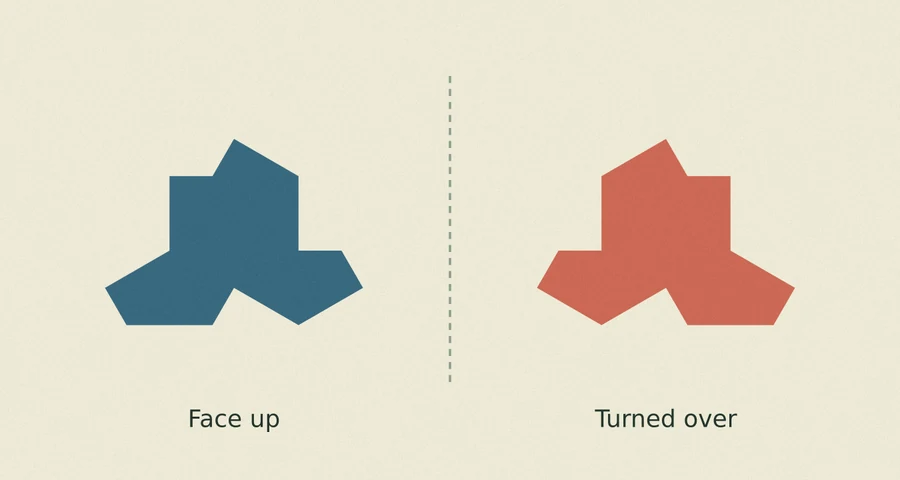
David Smith, Joseph Samuel Myers, Craig S. Kaplan and Chaim Goodman-Strauss published the mathematical result. A kitchen-table patch gives you a feel for the corners that lock together. A single small patch can look surprisingly orderly. The proof concerns what happens as you cover the entire plane.
The how-to
Step by step.
What to gather
- The authors’ linked browser puzzle, or identical paper outlines
- Thin card and a pencil if making a tabletop set
Open the Polypad puzzle linked by the authors and duplicate a supplied hat. For a paper version, follow the outline-file link on their project page, print one template and trace every piece from that same master. A freehand kink can stop the edges meeting.
Lay three pieces face up and flip a fourth over. Put a small dot on the flipped face. Try to arrange neighbours around its corners, turning pieces and matching two adjoining edges wherever you can.
When a piece leaves a narrow gap, remove the last two and try a different orientation. Compare your patch with the coloured example on the authors’ page. A promising local fit does not guarantee you can continue outward.
Editorial sources
From this discovery